
Eye rubbing
Frequent or forceful eye rubbing is a major warning behavior, especially in people with allergy or itchy eyes.
Keratoconus is a progressive corneal disease where the clear front surface of the eye becomes thin and bulges into a cone-like shape, causing distorted vision, glare, changing glasses numbers, and difficulty with night driving.
Keratoconus cannot be corrected safely by ordinary LASIK. At Kabra Eye Hospital in Jaipur, the priority is to map the cornea, identify progression, stabilize suitable eyes with corneal collagen cross-linking/C3R, and improve useful vision with glasses, specialty lenses, or advanced corneal surgery when needed.
Keratoconus can be missed when changing vision is treated only as routine spectacle power. Corneal mapping is important when symptoms and prescriptions keep changing.
Keratoconus decisions are time-sensitive because younger, progressing corneas may benefit from earlier stabilization. A cornea specialist can compare scans and decide whether observation, C3R/CXL, lenses, or another plan is appropriate.
Frequent or forceful eye rubbing is a major warning behavior, especially in people with allergy or itchy eyes.
Keratoconus often appears around adolescence or early adulthood and may progress faster in younger patients.
A family history of keratoconus or unexplained high astigmatism should prompt earlier corneal screening.
Chronic eye allergy, itching, asthma, eczema, or allergic tendencies can be associated with rubbing and corneal stress.
Diagnosis is not based on symptoms alone. It combines refraction, corneal examination, corneal maps, thickness data, and progression history.
The doctor checks current glasses power, astigmatism, best-corrected vision, and how stable the number has been.
The cornea is examined for thinning, scarring, cone shape, and other signs that may affect treatment planning.
Corneal mapping shows shape, steepening, thickness pattern, and early keratoconus changes that glasses testing alone can miss.
Old prescriptions, scans, age, symptoms, and repeat testing help decide whether the disease is stable or progressing.
Kabra Eye Hospital provides a hospital-based keratoconus pathway in Jaipur that brings corneal mapping, thickness measurement, ophthalmologist-led staging, C3R/CXL planning, vision rehabilitation, surgery counselling, and follow-up together in one location.
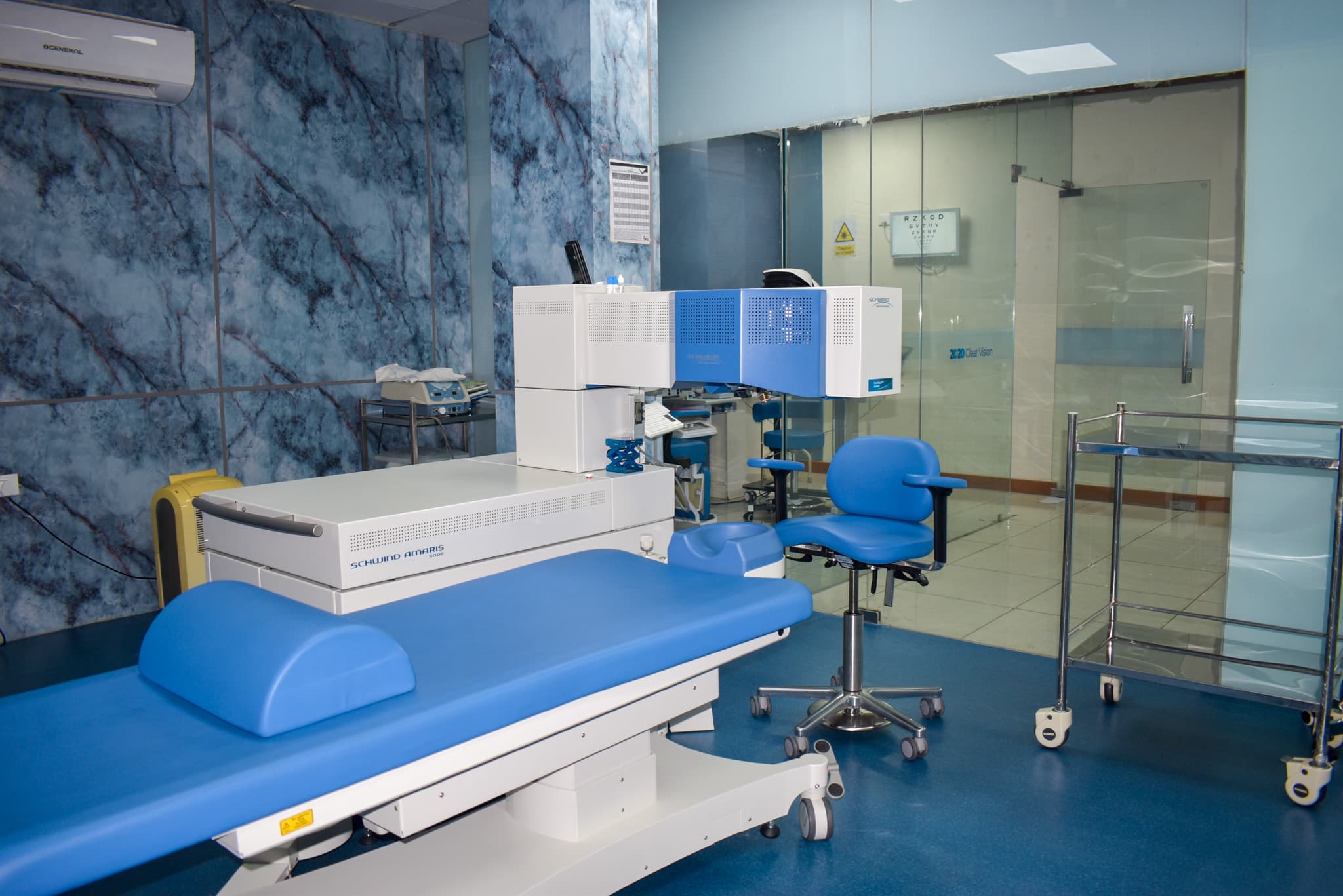
Kabra Eye Hospital's verified technology distinction is its Schwind Amaris platform for true no-touch Trans PRK in Jaipur. Trans PRK is a refractive procedure for eligible non-keratoconus eyes; it is not a substitute for C3R/CXL in progressive keratoconus.
C3R/CXL is mainly used to slow or halt progression in suitable progressive eyes. Glasses, specialty lenses, and surgical options are selected according to vision, corneal shape, scarring, and stage.
Early keratoconus may be managed with glasses or soft contact lenses when corneal irregularity is mild.
Specialty lenses can mask irregular corneal shape and improve vision when glasses no longer give clear results.
Cross-linking uses riboflavin and controlled ultraviolet light to strengthen corneal collagen and slow or halt progression in suitable eyes.
Selected patients may need corneal ring segments or corneal transplantation when disease is advanced, scarred, or contact-lens vision is not adequate.
A patient with keratoconus or suspicious corneal thinning may not be a safe LASIK candidate. Corneal topography helps protect patients from choosing a procedure that could weaken an already unstable cornea.
These answers are written plainly so patients can decide when to seek a cornea consultation and what questions to ask.
Keratoconus is a corneal disease in which the cornea becomes thinner and gradually bulges forward into a cone-like shape. This irregular shape can cause distorted vision, glare, halos, and changing glasses power.
Early signs include frequent changes in glasses number, increasing cylindrical power, ghosting or double images, glare, poor night vision, and vision that does not feel sharp even with new glasses.
Eye drops cannot reverse keratoconus. Allergy drops or lubricants may reduce itching and rubbing, but progression control usually requires monitoring and, in suitable progressive cases, corneal collagen cross-linking/C3R.
LASIK is generally not considered safe for keratoconus because it removes corneal tissue from an already weakened cornea. Patients wanting glasses removal need corneal mapping first to rule out keratoconus or suspicious corneal thinning.
C3R/CXL is a procedure used to strengthen the cornea in progressive keratoconus. It is mainly intended to slow or stop worsening, not to guarantee removal of glasses.
Many patients can achieve better functional vision with glasses, specialty contact lenses, or other treatment plans. The result depends on disease severity, scarring, progression, and lens tolerance.
Consult promptly if glasses power keeps changing, cylindrical number is increasing, night glare is worsening, one eye is much blurrier, or a child or young adult rubs the eyes frequently.
No. Most patients do not start with transplant. Many are managed with monitoring, cross-linking when progressive, and specialty lenses. Transplant is usually reserved for advanced disease, significant scarring, or poor vision despite other options.
Kabra Eye Hospital in Sodala, Jaipur provides keratoconus screening and treatment planning with corneal mapping, thickness assessment, C3R/CXL counselling for suitable progressive eyes, vision-rehabilitation options, and follow-up care.
An indicative estimate for treatment of both eyes is around ₹1,00,000 when bilateral treatment is clinically advised. This is not a fixed package: the final cost depends on scans, the procedure protocol, consumables, disease stage, and whether one or both eyes need treatment. A written estimate should be requested after examination.
Keratoconus care is available at more than one Jaipur eye centre. Kabra Eye Hospital's specific technology distinction is its Schwind Amaris platform for true no-touch Trans PRK. Keratoconus and Trans PRK are different pathways, and ordinary refractive laser treatment is generally avoided in an unstable keratoconic cornea.
This page is educational and does not replace an eye examination. Treatment suitability depends on clinical measurements and doctor advice.
Page updated 16 July 2026.Share the basics and continue on WhatsApp, or call the hospital directly if you need urgent scheduling help.